Science Cafe
Collaborating cities with conflicting interests
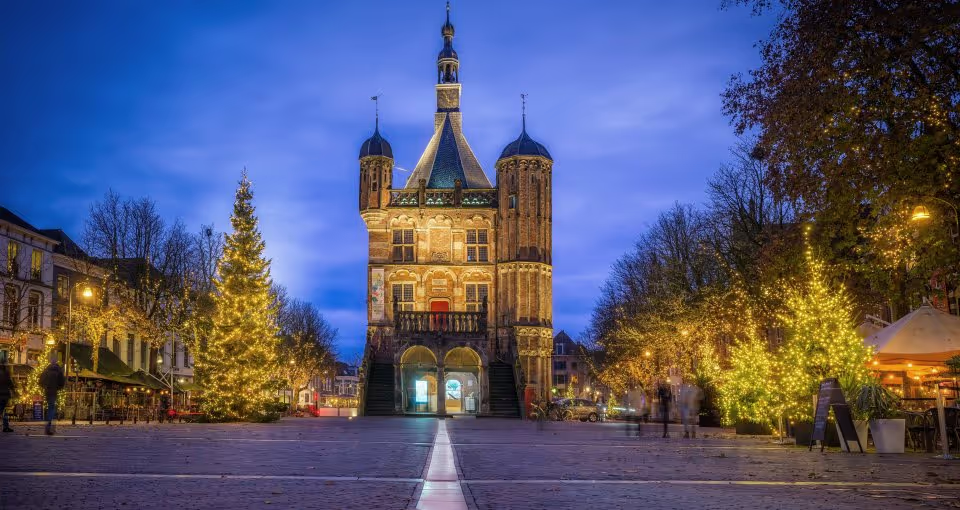
We have a Hanseatic road and a Hanseatic park in Deventer. We also have Hanze Staede offices, Hanze Keukens, Hanze ICT, Hanze Automobiles and many more Hanze in organization names. The people of the Hanseatic League (ca. 1350-1600) would be surprised to see the Hanseatic League as a role model in the 21st century. In any case, it shows that the word Hanze still evokes warm feelings.
That in itself is not surprising. Especially in the cities around the IJssel, the Hanseatic League is associated with a rich and prosperous past. Even before cities such as Amsterdam, Leiden and Dordrecht developed in the west, the Dutch Hanseatic cities were an integral part of the Hanseatic network that connected cities and markets around the North and Baltic Seas.
Merchants and skippers from cities such as Deventer and Kampen played a leading role in this. In addition, the IJssel cities in the Netherlands were a hinge between east and west. It was a position that brought them wealth and prosperity. Nevertheless, the Hanseatic League was not an example of peace and cooperation. Cities and merchants had different interests and often let opportunism and self-interest prevail. At the same time, the Hanseatic League was a historical phenomenon and a full of contradictions.
If you want to know more about the Hanseatic League and how historical research now views it from 'our' perspective, come to prof. dr. Hanno Brand's lecture.
He is a historian, former professor by special appointment at the University of Groningen and former director of the Fryske Akademy. He was previously affiliated with the Universities of Leiden, Ghent and Groningen and the German Historical Institute in Paris. He publishes and teaches extensively about the Netherlands and the Hanseatic League.
Live music is provided by Dubio and moderator is Lineke Tak.
