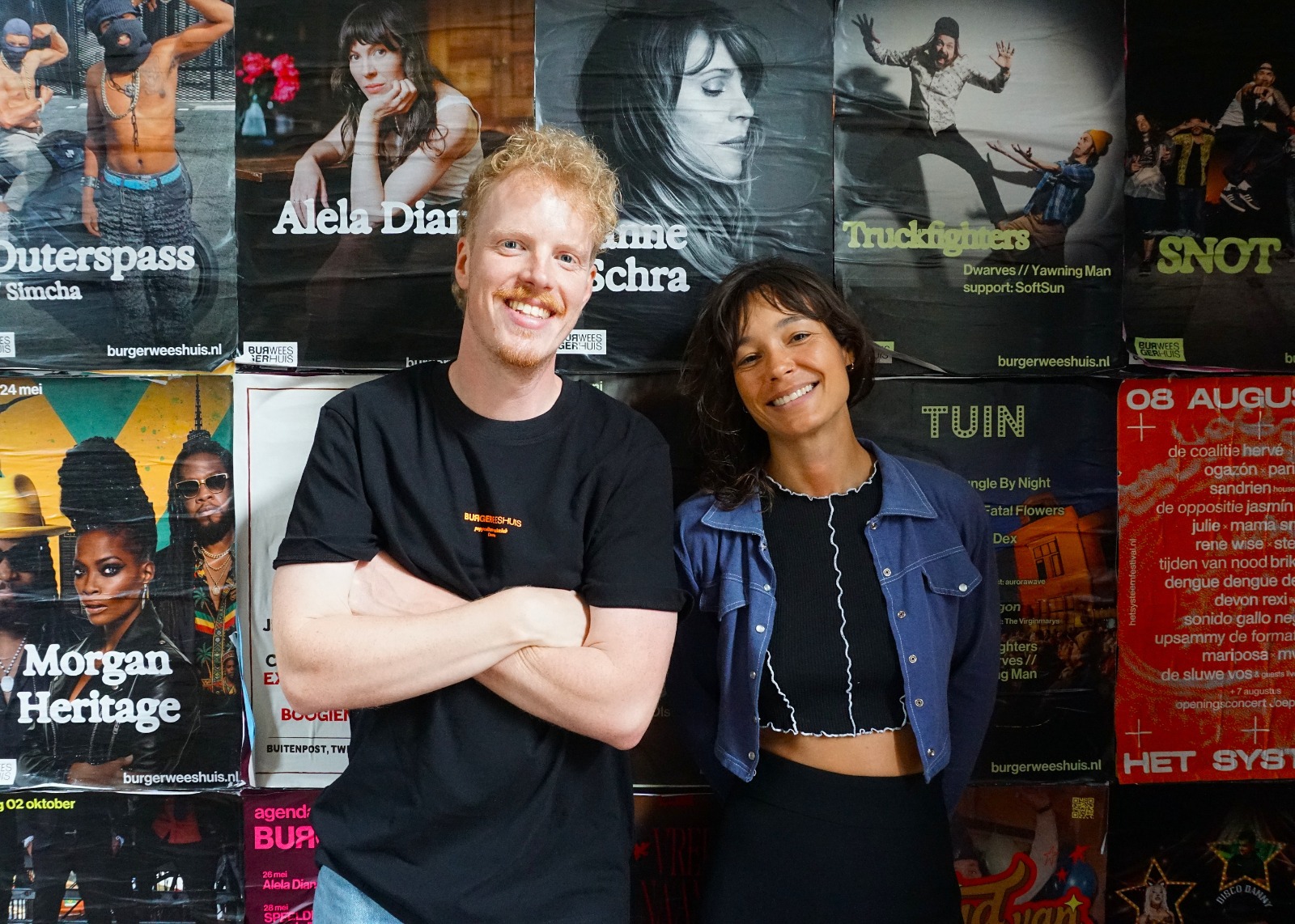
Double interview with Snelle and Babs.


Burgerweeshuis is turning 40. The body may be creaking and groaning, but the soul is very much alive. What defines this renowned Deventer pop venue, which grew out of a youth center in 1984? We’re finding out in six double interviews. This is episode 3, featuring Burger Beurs alumni Lars Bos, alias Snelle (Gorssel, 1995), and Babs Schutte, known simply as Babs (Leiden, 1999).
‘Let’s see if we run into any frogs today,’ Lars says as he descends the steel stairs into the vaulted cellar beneath the Burgerweeshuis. A moment later, in rehearsal room two, he and Babs flop onto the leather sofa next to the drum kit. It smells damp, musty, and familiar in here.
Lars: ‘This is my youth, a warm hug, a great place.’
Fifteen years ago, he first set foot across the threshold of the Burgerweeshuis. ‘For a concert by Flow&CO, a popular hip-hop group at the time. One of the members, Bruno Prent, was from Gorssel, just like me. I looked up to him. That’s how I also saw Zwart Licht here and other rappers I was a fan of. That’s when the spark was lit.’
SingStar and GarageBand
One hundred and fifty kilometers to the west lie Babs’ roots. In Leiden, the city of the Nobel pop venue. ‘But because I mostly listened to international artists, I didn’t go there that often. My first concerts were at the Melkweg and Paradiso.’ Babs’ spark was already burning back then. ‘As a little girl, I’d say at house parties or birthdays: “Everyone sit down, I’m going to dance for you now.” It didn’t matter that I couldn’t dance at all; I wanted to entertain.’
Babs: Being on stage is my way of expressing myself; everything is allowed there, I’m free.
Later on, when my parents let me pick an instrument, I was torn between the drums and the guitar. I went with the guitar because it makes songwriting easier. Eventually, I also bought a drum kit on Marktplaats—I wanted to become a one-woman band.’
The rappers Lars watched wore caps, so he started wearing one too. And they wrote rap lyrics in a notebook, so Lars did that too. ‘At home in the garage, I had a setup with a laptop and a microphone from the PlayStation game SingStar.’ Babs: ‘That’s nice! And then you recorded with GarageBand?’ Lars: ‘I think so, it must have been something like that, definitely not Logic. I’d take a beat from the internet and start rapping. I’d send the recordings to friends.’ He soon knew: this is it, this is what I’m going to do.
Lars smoked weed and made music, leaving school by the wayside. ‘I’m lucky to have a hardworking, entrepreneurial stepfather. “Artists are businesses too,” he drilled into me early on. Thanks to him, I realized it wouldn’t just happen on its own. I just had no idea what it took to succeed as an artist. Building a network and filing tax returns—that was as far as I got.’
‘The very first person who believed in me’
After high school, they both pursued music studies: Lars at the Herman Brood Academy, Babs at the ArtEZ Conservatory. Lars: ‘I thought it was brilliant. Getting student grants, living in a dorm, and making music all week—who wouldn’t want that?’
Babs: ‘I had a romanticized view and thought my career would work out fine as long as I finished that degree. I had chosen a production course, but in my third year, I realized I also wanted to make songs for myself and stand on a stage. But I didn’t learn that at school. I had no press photos and no money to have them made.’
Looking for support, Babs sent a demo to Kristel Nijs, who is responsible for talent development at Burgerweeshuis. ‘She was the very first person who saw the potential and believed in me. I really needed that; suddenly, doors opened in my head. I was very insecure and wondered if I was good enough.
At school, they had actually said: we don’t know if you’re going to make it.’ Lars: ‘I find that pretty harsh.’ Babs: ‘It wasn’t normal. And I was the only girl in the class, too. I felt like I wasn’t taken as seriously, even though I was working super hard.’
Resources, knowledge, network
The word self-confidence comes up, not for the first time in this conversation. Babs: ‘I needed that so much at that moment.’ Lars: ‘Very understandable. I think that applies to all artists. We are constantly looking for validation, narcissistic as we are.’ Babs: ‘If Kristel had said “just stop” at that moment, I might have quit right then. No, no, that’s not true. I’m a go-getter. But, but… it makes a big difference.’
Lars: ‘It’s actually crazy how much influence a Burgerweeshuis employee can have at such a moment. I give guest lectures at the Herman Brood Academy every now and then, and I always try to choose my words carefully. I try to be positive and, above all, provide practical tools.’
Following her contact with Kristel, Babs was awarded a Burger Beurs in 2021. For a year, she gained access to the resources, knowledge, and network of Burgerweeshuis, plus a budget to achieve her goals. After that, she knew what it took to be an artist.
Babs: ‘I felt: I can do this, I can stand on my own two feet now.’ Lars, who received the grant in 2017: ‘At school, you’re just one of many; it’s the personal attention that makes a big difference. The Burger Beurs is basically like a good manager for an emerging artist.’
It’s super important to have someone who can reach out to local media or put in a good word at the Bevrijdingsfestival Overijssel. It helped me a lot. And, let’s be honest, I could really use the money at that time too. Music videos, mixing, mastering, producers: everything costs money.’
Tens, twos, and sevens
Seven years on, there's no ignoring Snelle. He ranks among the most streamed artists in the Netherlands, has played all the major festivals, stars in his own Netflix documentary, and hosts TV shows. Babs is also making serious waves. Last year she scooped the Popprijs Overijssel, early this year she dropped her EP Half, competed on Wie is de Mol?, played several major festivals including Lowlands, and is currently working on her debut album.
Babs: ‘I’ve done a lot on my own over the past few years. It went well and I’m happy with where I am now, but I feel the need for input from others again, for help. Just like three years ago. My debut album is important to me, and I want to play in larger venues. That’s why it’s so nice to be here, at the place where I started as Babs the artist.’
Going back to the feeling of the year I had the Burger Beurs motivates me. Hopefully, I can take another step forward.’
Lars’s needs at this point in his career are more straightforward: keep going as is. ‘That just sounds so comfortable. On the other hand: what’s wrong with comfort?’
We only get one life, so for heaven's sake, make it comfortable.’ To push himself out of his comfort zone, he's heading to Nashville for a week later this year to write new music. ‘I hope to get inspired with fresh melodies and be blown away by other lyricists. Did you know Nashville is essentially an assembly line? They have tens, twos, and sevens—meaning studio sessions from ten to two, two to seven, or seven to eleven. Once the clock runs out, the songwriter just says, ‘Next.’ Talk about music as an industry.’
Grind, hustle, work!
When asked for their advice to future artists receiving the Burger Beurs, they say: you have to do it yourself.
Babs: ‘Keep pushing, keep working. Nothing just falls into your lap.’ Lars: ‘My advice for the grant year would be: grab every opportunity and stay open to feedback. Stay true to yourself, but don't be stubborn. Don't think you're too good to play for ten people standing on a crate at a community centre—it's actually great experience. And above all: run. Hustle, smash it, put in the work!’
Is there anything they would have done differently with the knowledge they have now? Babs: ‘I try not to look at it that way. With the mindset I had back then, I got the most out of it.’ And Lars? He thinks for a moment while looking around. Then: ‘I would have put a dehumidifier in the studio, but that’s really the only thing. Say, shall we head back outside?’
Photography: Isabelle Renate la Poutré
Interview: Job Hulsman