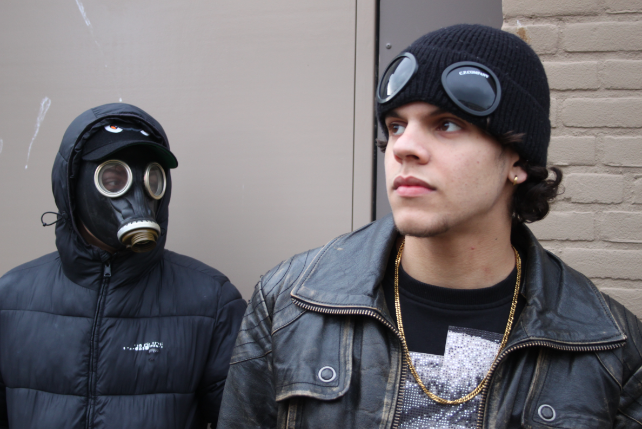
Double interview with De Sluwe Vos & Vieze Vedi


Burgerweeshuis is turning 40. The body may be creaking and groaning, but its soul is very much alive. What defines this legendary Deventer pop venue, which grew out of a youth center in 1984? We’re finding out in six double interviews. This is episode 2, featuring DJs Robert Vosmeijer (Twello, 1991) and Vedran Hadziavdic (Deventer, 1979).
While preparations are underway in the main hall for a Deventer municipal meeting, Vedran and Robert are lounging on a sofa in the Burgerweeshuis dressing room. Donnie, Vedran’s dachshund, is hopping around happily. "I’m often found here," says Vedran, "too often." To Robert: "Like recently, when you were playing here during Nachtparlement. I just end up sitting here. During parties I organize myself, I quickly feel self-conscious and prefer to stay upstairs in the hall."
As DJ Vieze Vedi, Vedran organizes events like Vediland and Pop Up. Put Vedi behind the decks and you’ll hear everything: hip-hop, house, R&B, lasers, dinosaurs, and karaoke. In the announcement for VEDILaND XXL during Liberation Night: "Has that slightly chubby little Vieze Vedi ever let us down with his parties?"
"After that, I was never called up for a match in the Go Ahead first team again"
Vedran knew he wanted to be a DJ by the time he was thirteen. "The first single I bought was Is It Good To You by Teddy Riley. As a teenager, I watched Yo! MTV Raps and listened to Dutch Masters on the radio." When he finally had the money to buy two turntables and a mixer at nineteen, he started DJing. Vedran became the DJ for the Deventer hip-hop group FATA and toured with rapper Kraantje Pappie. He also helped Jonathan Tan, alias Wantigga, organize BRRLNT, a dance party at Burgerweeshuis.
And then there was his adventure with Go Ahead Eagles. As a footballer, that is. "A few fun years," he says with an ambiguous smile. "I’d joined the second team on an amateur basis. After a few months, I was allowed to train with the first team, and during the winter break, I got an 18-month contract. Not long after, I was approached in the catacombs by Jan van Staa, the head coach at the time. 'What’s this I hear,' he said, 'you’re spinning records on the weekend?' I thought he was genuinely interested and started explaining. But he didn't listen and just walked away. After that, I was never called up for a match in the Go Ahead first team again."
Spoetnik and 9:23
Vedran is a born-and-bred Deventer local who wanted to be a DJ from a young age and has been organizing parties at Burgerweeshuis for years. It makes sense for him to be here for this nightlife interview. For Robert, who has an international career as a techno DJ under the name De Sluwe Vos, it’s a different story. He grew up in Twello and went to school in Apeldoorn. He is now inextricably linked to the Deventer nightlife, but things could have turned out very differently.
Robert was about thirteen when he heard L'Amour Toujours by Gigi D'Agostino through older scouts. "I thought: yo, what the fuck is this? A beat in the music—I’d never heard that before. My Dutch teacher then gave me a CD with techno and minimal, featuring tracks like Domino by Oxia and White Elephant by H.O.S.H.. I asked where he found that music, and he showed me the way. Then, on 3voor12, I heard a DJ set by Jesse Voorn. It turned out he was organizing his own parties at Burgerweeshuis: Spoetnik. My parents had read about it in the paper. 'Don't you want to go there?' they asked."
"I felt at home in the dance scene. Because of the mysterious music, the raw locations, and the open-minded people"
That’s how Robert ended up in a parallel world in Deventer at a young age. He started DJing at illegal raves in basements on Van Twickelostraat and began helping organize 9.23, famous club nights that later found a home at Burgerweeshuis. Robert: "Like everyone at that age, I was looking for the place where I belonged. I felt at home in the dance scene. Because of the mysterious music, the raw locations, and the open-minded people. I soon decided: I want to be active in music forever."
Burger Grant
A jump in time. 2015. Robert has finished his studies at the Herman Brood Academy, and his first record is done. He is now living in Amsterdam, and during the 5 DAYS OFF festival, he presents Kontra at the Melkweg. At Robert's invitation, many old friends are in the audience, including a delegation from Burgerweeshuis. "That performance didn't go well; there was no structure at all, the lighting was a mess, and it was all over the place. Burger said then: we see the potential, but it needs guidance. That’s when I received a Burger Grant. I was allowed to come here to rehearse, got two tour managers, a lighting and sound rig, and worked with a choreographer."
Barely five months later, he was in the Bravo tent at Lowlands, the second-largest stage at the festival. From that moment on, De Sluwe Vos took off: Pukkelpop, Lowlands again, Glastonbury, Fuse, Ministry of Sound, DGTL, and Awakenings. Robert, now with Donnie on his lap: "Crazy, right? I was at school in Twello; nobody at school in Apeldoorn was interested in Deventer. I discovered the nightlife here by chance. What if that hadn't happened? Deventer, and Burger in particular, shaped me musically and made me who I am today as an artist. It might be in you, but it also has to come out."
Marcel Dettmann, Helena Hauff, and Stingray
The appreciation is mutual. After periods in Amsterdam and Haarlem, Robert is now living in Deventer again, where the nightlife has developed significantly in his absence. With events like VroegZat, Vediland, Boogie Nights, and Nachtparlement, Burgerweeshuis offers something for everyone. Robert: "The night is alive in Deventer. Personally, I feel the most affinity with Nachtparlement. Their programming is insane. Marcel Dettmann plays here for five hundred people, just like Helena Hauff." He points to the sofa where Vedran is sitting: "I’ve chilled with DJ Stingray right there. Isn't that crazy? I’m always happy when I end up at Burger after a gig somewhere in the country or abroad."
"As a DJ, you’re right there among the people; you can smell everyone"
What is the charm of the Burgerweeshuis as a nightlife venue according to Vedran? ‘It’s very intimate for such a large hall. With my own parties, I try something different every time in terms of decor and setup, and it always works out. As a DJ, you’re right there among the people; you can smell everyone.’ Robert: ‘Burger is the essence of a venue: a stage in a black box with a bar in the corner. Everything is stripped back; it is what it is. Nights there quickly become pure.’
The DJs do have some wishes regarding venue capacity. Robert: ‘The step from the Walhalla youth center to here is quite big for a club night. Filling a large hall means appealing to a large audience, whereas subgenres are also very interesting.’ Vedran: ‘Deventer actually lacks a venue for 150 to 200 visitors. That’s just a bit safer and more inviting.’
Stroom, a creative powerhouse
They envisioned it perfectly when the Burgerweeshuis presented plans to move to Burgerhaven. The Burgerweeshuis used the former factory building in the Havenkwartier temporarily during the COVID-19 pandemic. Vedran works across the street at Burnside, which opened a café last year. Alongside Burgerhaven, the Burgerweeshuis developed Stroom, the ‘creative powerhouse’ where Robert, like other Deventer musicians, has had a studio for a year. The building houses a large rehearsal space where bands from all over the country can hold residencies, and knowledge and inspiration evenings are organized there.
‘Places like Burger aren’t planned, they’re made’
Vedran lets out a deep sigh: ‘I still have quiet hope. The picture is just right. Deventer is a diverse city with different target groups. It’s nice to have your own place where you aren’t a nuisance to anyone, and it’s so close to the center, too.’ Robert: ‘The core of nightlife is being able to clear your head, to escape from daily reality. And to come together. When I think about how much that has meant to me, when I see everything that has blossomed from a place like the Burgerweeshuis – how much that has meant for Deventer.’
A silence fills the dressing room. Donnie barks and walks to the door; he needs to pee. Then Vedran says: ‘It will be alright. Deventer is home to many creative people. Someone will always step up and create something new. Places like Burger aren’t planned, they’re made. If not in the harbor, then somewhere else.’
Photography: Isabelle Renate la Poutré
Interview: Job Hulsman