Science Café: Animal-free research
Animals are just like humans, and vice versa.
Dogs start to resemble their owners, and owners look for a dog that suits them. We attribute human personality traits to animals and study their behavior to better understand ourselves. Physically, too, animals—especially mammals—are very similar to us. That is why animals are widely used in scientific research, not only to better understand the animals themselves, but also to test the efficacy and safety of medicines and chemical substances (such as cosmetics). Fortunately, we consider experiments on humans to be ethically unjustifiable, but what about animal testing?
Bas van Balkom, affiliated with the University Medical Center Utrecht, will discuss his research into replacing animal testing with reliable laboratory systems wherever possible. This turns out to be easier said than done. Although mammals and humans are physiologically similar, mammals often differ significantly from us. In many mammals, the immune system is fundamentally different from that of humans. Furthermore, their organs often differ in size from ours. Their bodies frequently absorb and process external substances differently than the human body. Moreover, humans often exhibit very different side effects from substances than mammals do. Finally, the purpose of medicine is to cure a disease, but that disease may have already impaired various bodily functions—something that is very difficult to replicate in animals. Animal testing often proves to be pointless as a result. Furthermore, almost all laboratory animals are euthanized after experiments, which no researcher enjoys. Hence the search for viable alternatives.
As Van Balkom’s talk will demonstrate, this is no easy task. Laboratory research is often conducted using human cells, but those isolated cells are not a good model for the complex interaction between different organs and between healthy and affected cells in the body. You therefore need a laboratory setup where you can observe different types of cells working together and reacting to one another. Van Balkom will explain the current state of affairs and the future outlook.
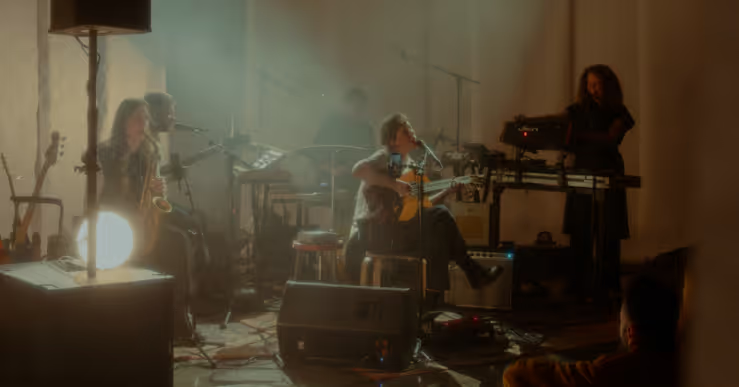
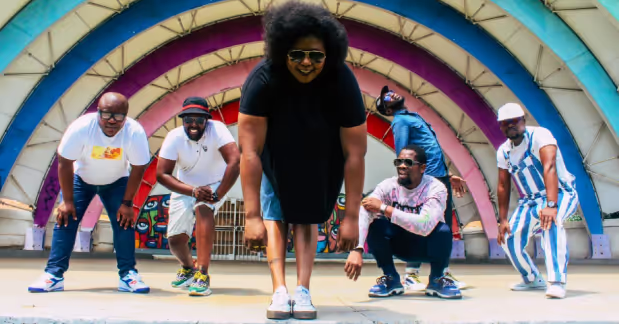
Live music will be provided by Dubio, and Ilse Roelofsen will moderate the discussion after the break.

.avif)